


Private poker games represent one of the most common deployment contexts for poker analyzer systems. Unlike commercial casino environments, private games occur in homes, clubs, rented venues, and private spaces where regulatory oversight is minimal or absent entirely. This article examines the technical, operational, and practical considerations for deploying AKK, CVK, and CAC series poker analyzers in private game settings.

The Private Game Landscape
Private poker games span a wide spectrum—from casual home games among friends to organized private clubs with significant buy-ins and professional players. The common thread is the absence of state gaming commission oversight. This creates both opportunities and risks. Without regulatory constraints, operators of private games have greater freedom in equipment choices. However, the social dynamics of private games introduce unique challenges that differ fundamentally from commercial casino operations.
In a private game, the player field tends to be consistent over time. Regular players develop familiarity with each other’s behavioral patterns, betting styles, and tells. Introducing a poker analyzer into this environment requires careful attention to behavioral integration, as statistical anomalies are more easily noticed when the player pool is small and well-acquainted.
Technical Requirements for Home Deployment
Compact Form Factor Considerations
Private game environments favor discreet, portable equipment configurations. The ideal home deployment setup prioritizes concealment over maximum processing power. Compact AKK and CVK devices that fit within a jacket pocket or small personal item provide the necessary discretion for home game scenarios where physical inspection of players’ belongings is uncommon.
Battery life becomes a critical consideration in home settings. Unlike casinos with constant power access, home games may occur in locations with limited or unreliable power outlets. A fully charged poker analyzer should provide a minimum of six to eight hours of continuous operation without requiring a recharge. Battery capacity directly impacts device weight and form factor, creating trade-offs that must be evaluated based on the specific deployment environment.
Connectivity and Range
Many modern poker analyzer systems support remote communication accessories, including invisible earpieces and remote control modules. In a home environment, signal range requirements are typically modest—line-of-sight or within a single room. However, interference from home Wi-Fi networks, Bluetooth devices, cordless phones, and microwave ovens can degrade communication reliability.
Before deploying a poker analyzer in a private game, operators should conduct a site survey to identify potential sources of signal interference. Repositioning the analyzer device, adjusting wireless channel settings, or using shielded carrying cases can mitigate interference issues in challenging home environments.
Barcode Marked Cards for Private Games
The effectiveness of any poker analyzer depends fundamentally on the quality of the marked cards used in conjunction with the device. For private game deployments, barcode marked cards offer significant advantages over infrared marked alternatives in certain contexts.
Barcode marked cards encode player hand information and community cards in a series of subtly altered patterns along the card edges. These patterns are invisible to the naked eye under normal lighting conditions but can be reliably read by barcode scanning poker analyzers. The marking process can be applied to standard Bicycle, Copag, or Kem playing cards commonly used in home games.
Key advantages of barcode marked cards for private games include:
– Compatibility with standard card sizes and finishes
– Relatively straightforward marking process that can be applied to multiple decks
– High durability—the barcode markings resist wear from shuffling better than some infrared marking methods
– Lower cost per deck compared to custom-manufactured infrared marked cards
Operators should note that barcode marked cards require the scanning device to have direct optical access to the card edges. This means the analyzer must be positioned in a location where it can clearly view the cards as they are dealt—a positioning challenge in casual home settings where card dealing may be irregular.
Configuring AKK Devices for Home Environments
AKK series analyzers offer configurable sensitivity settings that can be optimized for home game conditions. In a typical home environment, lighting may be suboptimal—overhead lights, lamps, or natural sunlight from windows can create uneven illumination that affects scanner accuracy.
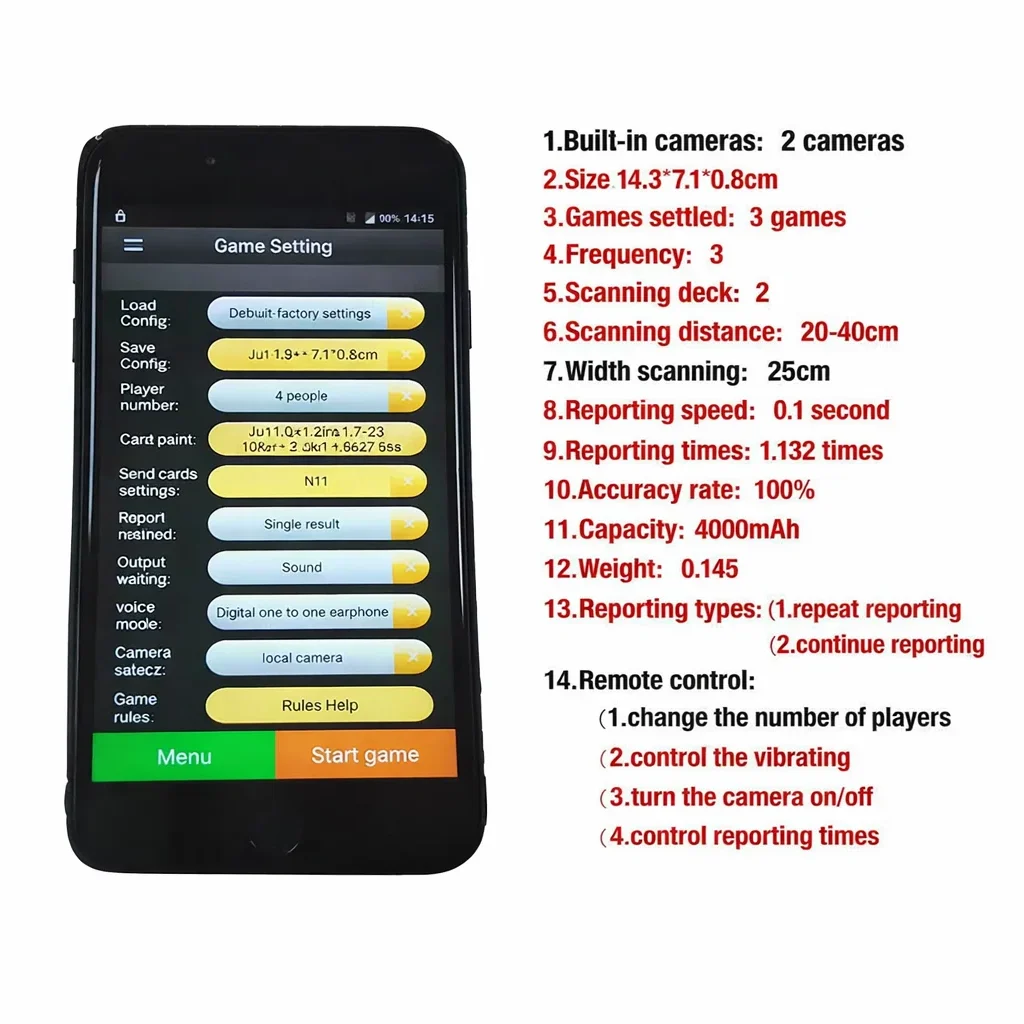
The AKK configuration process for home deployment involves:
1. Lighting calibration: Running the device through its calibration routine with the actual lighting conditions of the game space
2. Card deck registration: Inputting the specific deck configuration and card back pattern to optimize scan accuracy
3. Player count adjustment: Setting the device to recognize the number of players at the table, which affects algorithm predictions
4. Game variant selection: Configuring for the specific poker variant being played, whether Texas Hold’em, Omaha, or another format
5. Audio output tuning: Adjusting the volume and frequency of the invisible earpiece to suit the ambient noise level of the home environment
Operational Security in Private Settings
The primary risk in private game deployments is not regulatory—it is social and reputational. Private games depend on trust within a defined social circle. If the use of a poker analyzer is discovered by other players, the consequences extend beyond legal liability to severe social fallout.
Operational security measures for private game deployments include:
– Physical concealment: The analyzer device should be indistinguishable from common personal items. Modern compact devices are small enough to fit in a belt-mounted pouch or a modified mobile phone case
– Behavioral pacing: Winning sessions should be distributed naturally over time. A player who suddenly and dramatically outperforms their historical performance will attract scrutiny
– Card handling coordination: In games where the subject operates as the dealer, card scanning occurs naturally during dealing. In games where the subject is a player, coordination with the dealer becomes necessary—some analyzers support delayed card data entry to accommodate non-dealing positions
– Signal discipline: Earpiece audio should be set to barely perceptible levels. Any visible reaction to audio information represents a significant operational security failure
CVK Integration for Home Tournament Formats
Private poker games frequently employ tournament formats rather than cash game structures. The CVK series poker analyzers offer specific advantages for tournament deployment, including multi-stage blind structure support and independent player stack tracking across tournament levels.
Configuring a CVK device for a home tournament requires inputting the complete blind structure, including antes, small blinds, big blinds, and level durations. The analyzer uses this information to adjust probability calculations based on the tournament stage and remaining stack sizes—a feature that significantly enhances prediction accuracy in tournament contexts.
Home tournament operators should ensure that the number of players configured in the device matches the actual field. Misconfiguring player count results in incorrect pot equity calculations and reduced prediction reliability.
Common Failure Modes in Home Deployments
Several failure modes are particularly common in private game environments:
Lighting inconsistency: Home games may feature overhead pendant lights, table lamps, and natural window light in varying combinations throughout a session. Sudden lighting changes—such as someone turning off an overhead light—can cause scanning accuracy to degrade momentarily.
Card shuffle inconsistency: Unlike casino environments with trained dealers using consistent shuffling techniques, home games often feature irregular shuffles, riffle patterns that damage card edges, and poorly shuffled decks that result in clumped barcode patterns.
Ambient noise interference: The invisible earpiece must compete with conversation, music, television, and other ambient audio in home settings. Players who speak quietly during critical betting rounds may have their audio input masked by environmental noise.
Equipment failure in variable conditions: Home environments lack the climate control of professional gaming spaces. Temperature and humidity fluctuations can affect both the poker analyzer electronics and the physical properties of marked cards.
Conclusion
Private game deployment of poker analyzer systems requires careful attention to environmental factors, operational security, and the specific technical requirements of the devices being used. While regulatory concerns are reduced in private settings, the social stakes of detection demand rigorous operational discipline. Success in private game environments depends not on having the most powerful analyzer technology but on deploying that technology within a carefully managed operational framework that respects the unique dynamics of small-group, trust-based poker play.
Frequently Asked Questions
Q: What is the recommended poker analyzer model for small private games with six players?
A: Compact AKK series devices are generally preferred for small private games due to their portability and ease of concealment. The CVK 600 is also suitable for these environments when tournament formats are involved.
Q: How do I prevent signal interference from home Wi-Fi networks?
A: Change the analyzer’s communication channel to a less congested frequency, position the device away from Wi-Fi routers, and consider using shielded carrying cases to reduce electromagnetic interference.
Q: Can barcode marked cards be used with standard card shufflers?
A: Most barcode marked cards are compatible with standard mechanical shufflers, though automated shufflers should be tested before game use, as some models can degrade card edge markings over repeated cycles.
Q: What battery life should I expect from a poker analyzer in a home tournament setting?
A: Expect between six and ten hours of continuous operation depending on the model, screen brightness settings, and frequency of scans. Always bring backup power supplies for extended tournaments.
Q: How do I manage the risk of other players noticing unusual winning patterns?
A: Distribute wins naturally over time, avoid showing emotional reactions to audio input from the earpiece, and consider varying your betting strategy to incorporate some deliberate losses that align with your apparent skill level.
